
Home Renovation in Fort Saskatchewan: Behind the Scenes of Our First Home Flip Project
Hey all, it’s Jim with Fort Sask Renos, and I’m here with Tom. We’re the owners and operators of Fort Sask Renos, so we’re here today to discuss the renovation project we’ve got going in Fort Saskatchewan.
Introduction to the Pine View Flip
This one is actually our first flip project, where we’ve taken a bungalow in the Pine View area. It was a single-family home, original to 1971, I believe. We pretty well gutted it inside and out, and we’ve got a complete renovation there.
We’re getting near the end stages of that, and we have installed a legal basement suite. So the topic for today is really just discussing that road from purchase to where we’re at currently, and we can share some of the learnings of the process if you should choose to get yourself a legal basement suite. We’ll be able to enlighten you somewhat on what we’ve learned and what’s required to make it happen in the Fort.
Current Project Status and Renderings
Tom’s done the lion’s share of the lifting on this project, so we’ve got him in here today to shed some light on some of the learnings. Given that, Tom, can you give us a few words about the project and where we’re at currently? Then we can get into the questions from there.
Tom: Yeah, for sure. It’s been a fun project for the whole team. We’ve all put in a lot of effort into this place to get it tuned up—lots of blood, sweat, and tears. Where we’re at today is the basement is just in the finishing stages. We’re getting our kitchen installed, and the guys are hard at work painting down there today. My mom’s over at the house giving the upstairs—which is pretty well finished up—a deep clean.
We got our renderings live on social media so people can have a good look at what it looks like when it’s all cleaned up and stuff like that, ’cause at the moment we can’t take any good pictures. We’ve got building wrap on the counters to protect them and all of our tools and stuff like that. But just like when you buy a new home, you usually buy a new home based on a rendering. You don’t typically get to see the home built before the excavator gets there and digs the foundation and so on and so forth. That’s the way of the future with the renderings, right?
Jim: Yeah, for sure. It really helps visualize stuff too. Paulo, our architect, had done some renderings and edited them recently, so it was nice to see what the light will look like before I even ordered it. We’ve got it in the Amazon shopping cart right now with two-day delivery once we’re ready. I just don’t want it to get dusty in the meantime. Nice. So yeah, we’re finishing touches on the upstairs and the basement. We just got a couple bigger things to get installed—finished up next week, like the baseboard and the paint, the kitchen. And yeah, we’re ready to hand the keys over.
Jim: Nice. And we’re looking at, it’s what, 85% complete at this point?
Tom: Roughly, yeah. That’s a good mark, give or take.
Jim: And what kind of timelines are we looking to get her buttoned up finally?
Tom: We’re hoping to have it completed in the next 30 days for sure.
Jim: Yeah, and if anyone’s interested in buying it, we’re more than happy to start showing it. It’d be ready. There’s some customization that can still be done, too. That’s what I always had in the back of my mind: if I did find a buyer before the paint was done, well, they may as well pick the paint colors and stuff like that.
Tom: Yeah, going to have to be quick though, ’cause we’re getting close. That ship is sailed now.
Challenges of Installing a Legal Basement Suite
Jim: Very good. So, let’s discuss some of the challenges. It’s been a learning process, and it has been challenging even for us as seasoned professionals. We’ve got 18 years in business in renovations in Fort Saskatchewan and area, really the whole Edmonton area, and it still has been a challenge for us because it’s a little bit of a different kettle of fish than an average project—doing a legal basement suite. There are legal requirements and hoops to jump through. If you could speak to that, what have been some of the more important challenges or difficult things you’ve had to overcome here to get us to this point?
Tom: Yeah, for sure. It’s been a challenging process, but we knew that going into it. Our business coach kind of advised us that we might not make any money on this one, but we’re investing in a learning experience basically. And that’ll probably hold true, but on the next one I’m sure it’ll go a lot smoother with what we’ve learned.
Main Floor Open Concept and Structural Safety
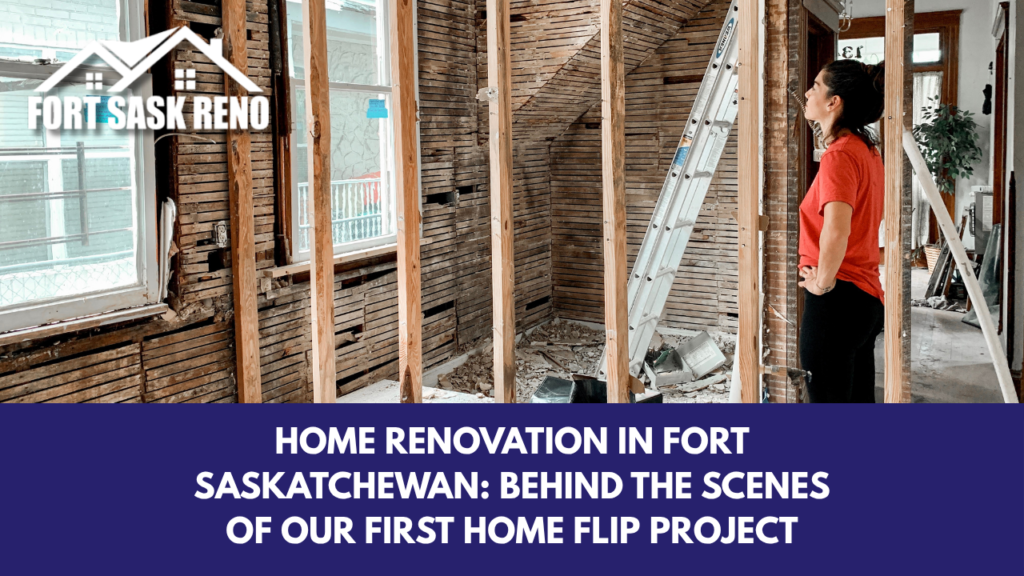
Some of the bigger challenges, for sure, were removing the wall that separates the main floor kitchen from the living room, because everyone wants an open-concept main floor now. It’s just the thing of the times. You don’t really see the way they used to build them in the ’50s and ’60s, where everything’s super cramped and constricted, crowded feeling. So that was one of our big hurdles we tackled first: removing the wall that separates the kitchen and the living room. With that, we had to modify the electrical, the ducting, and also retexture the whole ceiling. So that one wall removal ended up being a lot of work.
Jim: And with the wall removal, what’s important for the average homeowner if you think you’re going to remove a wall and just open up a space? How do you know you can do that or not?
Tom: Well, step one: if your home is older than the 1980s, you should test for asbestos. That’s important—you don’t want to expose your family to asbestos. Take it to Cobalt Analytics, get it tested, and make sure, step one, it’s safe to do so. Step two is make sure that your roof isn’t going to fall in if you take that wall out. You’ve got to make sure you either will have to add a beam, and if you have engineered joists, maybe you’re in luck—like we were. We didn’t have to add any beams ’cause our home is balloon framed. All the weight spans to the exterior walls, so we got lucky there. We had engineered rafters. That was important. And then, of course, making sure that your electrical and all the plumbing and anything that’s in that wall is taken care of properly—you don’t want to cut any shortcuts there.
Jim: Yeah. I think you hit the nail on the head there. We’ve seen it before where people have no clue what they’re doing: “Well, I just removed that wall,” and it could be a load-bearing wall, and you could really be causing yourself some issues if you ever go to try and sell a house and you’ve removed a load-bearing wall. Bad news. So that’s something that’s important to know.
Logistical Hurdles and Building Code
And like, what have been some of the main challenges you’ve experienced running through this project to get a legal basement suite? Some of the main challenges would be the removal of the wall that separated the kitchen from the living room—that was a big project, from texturing the ceiling to redoing the electrical that was in that wall, the ducting and whatnot. So that was a big one for sure. Making sure we did it right. We do have balloon framing in that ceiling there, so that made it nice—we didn’t have to add a structural beam. It was quite challenging just to remove that wall, but the payoff in the end is well worth it. When you walk in the front door now, you can see the beautiful kitchen with the quartz counters and a nice aisle in there. That was one of the biggest challenges for the main floor.
As well, main floor laundry was a real struggle to figure out logistically what was going to work well. We tossed and turned over and over trying to figure out how to get doors on the laundry to make it a closed-in space, but in the end, we decided to leave it open and expand the closet area out to accommodate the washer and dryer. We ran the ducting out the front of the house and it worked out really nice. We added some built-in shelving, and it came out quite nice—just a dedicated laundry room. You could still use it as a bit of a flex room even, but yeah—some interesting challenges there.
Jim: Anything else in terms of code issues?
Tom: Yeah, for sure. The code was a tough one. The code book is 1,570 pages, and it’s made by a lawyer, so you almost need to be a lawyer to interpret it half the time. I mean, I asked ChatGPT quite a few questions on it. But luckily there are some good inspectors in the Fort. Some of the code requirements: a continuous layer of half-inch drywall on the ceiling throughout the whole suite, as well as the utility room had to have the entire thing drywalled. Another code requirement was sound dampening—we had to install fiberglass batt insulation in the whole ceiling of the basement, as well as a resilient channel, so it’s nice and quiet down there now.
Surprises: Vapor Barriers and Groundwork
There was something with some vapor barrier under the framing in the basement—what was that all about?
Tom: So it’s a common combination we run into. Basically what it is: you need to have a layer of poly underneath your base plate if it’s not treated. I had the inspector dig out his 1970s code book and he said even back then there was that poly underneath the base plate. That meant we were digging up all the base plates and wrapping them in poly. It was a big job throughout the whole basement—pretty much reframing part of the whole basement at that point.
Kitchen Design: Upstairs vs. Downstairs
Let’s talk about the kitchen. It’s one of the bigger selling points in any home, so tell me about the kitchens upstairs and downstairs.
Tom: Upstairs, after the wall was done, it opened up some space for a nice island. I was able to install the ducting in the toe kick of the island and hide it. We did a white shaker cabinet and some quartz to really make it pop. At first it was a little clinical, but once we got our tile in with the backsplash and some darker grout, it really flows nicely. Before, the kitchen was all just on one bank, but now we have an L-shaped kitchen.
Jim: In the basement, is it a carbon copy?
Tom: That one was quite the thing to figure out. We got a little creative there. We have our plumbing and our electrical runs underneath the concrete to our island, so that way we can have the sink and the dishwasher in the island. It’s small, but it’s only a one-bedroom suite down there. That one is just smooth white cabinets. We’ve got the custom tile shower and all that as well. It used to be a half bath down there, so it was a lot of work to get that to a full bathroom. We switched the furnace 180°, and that allowed us to double the size of the washroom.
Permitting and Mechanical Requirements
Permitting—what are some of the permitting challenges that folks should know?
Tom: Well, first and foremost, it was expensive. I think we’re probably into it close to $2,000, and that doesn’t include the prints. Following all the very strict code requirements was challenging. We needed to make sure we had the HRV (heat recovery ventilation system) and that separate heat source. We also had to make sure we had the egress window, fire-rated drywall in the ceiling, and soundproofing.
Jim: And the backflow prevention?
Tom: Yeah, we had to make sure that if the upstairs backed up, it wouldn’t flood into the basement suite. That one caught us by surprise. Luckily our plumber came in there and he was able to get it done in one day: pop the backflow preventer in and get us code-compliant.
Electrical Demands and Load Misers
How about power issues?
Tom: A lot of these older homes probably came with a 60-amp service. We thought we were set with 100 amps, but that doesn’t go that far. Our first electrician actually said it wasn’t possible. But the next electrician had a couple tricks up his sleeve. He set us up with a load miser system. That just limits how much load can be consumed at one time. Basically, if the upstairs tenant wants the AC on and the basement suite wants the baseboard heaters on, that’s not going to fly—it’ll cut power to the AC. But there are pretty high power requirements because we’ve got two of everything: two washers, two dryers, two stoves. We installed pot lights throughout the whole house and interconnected smoke alarms as part of the code requirement.
Exterior Renovations: Siding and Windows
We’ve talked about the interior quite a bit—what’s been done on the outside?
Tom: We started off with brand-new triple-pane windows from Lux. They’re really high-end windows. Then we installed two new exterior doors: the front door with ¾ glass and the rear door with half glass. Then we got the siding buttoned up. The home was stucco, so we added a small 3/8″ leveler insulation and from there we did vertical board and batten siding on the entire home. It’s a timeless look in white.
Final Thoughts and Advice for Homeowners
Any final advice for folks listening who want to undertake a Fort Saskatchewan Home Renovation?
Tom: I would touch on the fact that even being in the business for over 17 years, it was a challenge for us. Sometimes this was a back-burner project for us, but it was extremely challenging. If you’re trying to tackle it yourself, you’re going to have to get familiar with the inspectors. In the Fort, it’s less than a 1% vacancy rate, so we really need basement suites.
Jim: It makes it a little easier when the house is already designed for that in newer areas of Fort Saskatchewan. But for folks trying to undertake this on their own, you’re going to have to do a lot of studying. We’ve got an architect on staff, so that’s been really helpful in the construction drawings, which are mandatory for all your permitting. If you don’t want to undertake this type of project, of course Fort Sask Renos—we’re here to help you. You can definitely contact us for a free estimate.
Tom: Thanks for joining us on another YouTube video. Like, subscribe, and all those good things. We’ll see you next time.